GPO Enforced: What It Means and How It Differs from Block Inheritance
Context
In almost every Active Directory environment there is at least one critical GPO that someone has "forced" to solve an immediate priority. A decision made in good faith to solve a business problem can eventually become the largest problem in the domain.
The problem is not that Enforced and Block Inheritance are inherently bad. The problem is that they are often used as a quick fix instead of a controlled exception. Operationally, GPO Enforced and Block Inheritance are powerful tools, but they must be treated as governance decisions, not last-minute configuration tweaks.
This guide starts from a simple point: if you understand the GPO precedence model and the real behavior of Enforced and Block Inheritance, you can prevent one exception from becoming a domain full of invisible drift.
Why this topic is dangerous
GPOs are processed in a defined order, but interpreting their behavior in production is not always immediate. Most real incidents are not caused by one badly configured GPO, but by a combination of:
- GPOs linked to the domain;
- GPOs linked to OUs;
- inherited-policy exceptions;
- parent OUs containing baseline policies;
- critical GPOs marked
Enforced; - OUs where
Block Inheritancewas enabled to solve a local problem and never removed.
The domain can look stable during standard checks while a set of exceptions silently changes security, compliance, and policy-application behavior.
The key points are:
Block Inheritancedoes not delete a policy: it removes it from the inheritance flow for the OU branch;Enforceddoes not make a GPO infallible: it changes precedence in a conflict;gpresultandRSOP, or Group Policy Modeling, are needed to define the effective precedence and policies applied to the target.
How GPOs really work
Before discussing Enforced and Block Inheritance, reconstruct the GPO application model.
Application order: the base levels
GPOs are processed in this order at domain level:
- Local Group Policy
- Site policy
- Domain policy
- OU policy
- Child OU policy, when present
This sequence is commonly remembered as LSDOU: Local, Site, Domain, OU. To see which setting wins, imagine that the same setting, Interactive logon: Message text for users attempting to log on, is configured with a different value at each stage:
Local Group Policysets valueAon the computer.Site policysets valueBfor the Active Directory site.Domain policysets valueCfor the domain.OU policysets valueDfor the OU containing the domain computers.Child OU policysets valueEfor the most specific child OU containing the target computers.
If all five policies apply to the same computer and there are no filters, E is the final value: the child OU policy is processed last and prevails over the parent OU, domain, site, and local values. If the child OU does not configure that setting, the result is D, then C, B, or A. The value does not win merely because a policy is lower in the tree; it wins because it is the last effective value for that specific setting.
This is the base rule for normally inherited GPOs. Security Filtering, Block Inheritance, Enforced, loopback processing, and other mechanisms can change which GPOs actually reach the computer or user. Confirm the effective result with gpresult or RSOP.
Conflicts at the same level
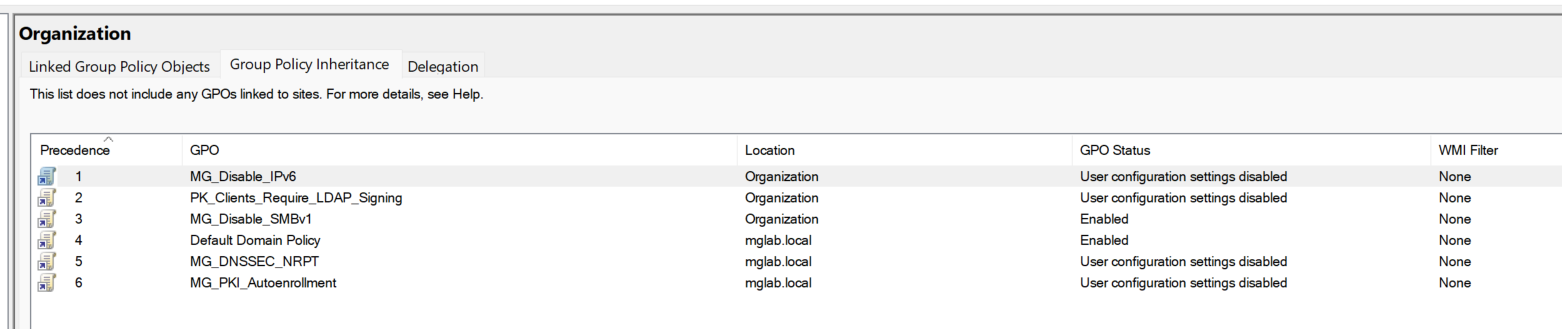
When multiple GPOs are linked at the same level, precedence is determined by their link order. In GPMC, the GPO at the top of the linked-object list has the higher priority. A poor link order can therefore look like an orchestration bug even without Enforced.

Where Enforced fits
Enforced changes the precedence of a specific GPO. A GPO marked Enforced at a higher level continues to be inherited through a child OU with Block Inheritance; Block Inheritance blocks normally inherited GPOs, but not Enforced ones.
For example, if GPO-Domain-Baseline is linked to the domain with Enforced and OU=Production\Workstations has Block Inheritance, the baseline still applies to objects in the child OU. If the domain GPO were not Enforced, it would be excluded by the child OU's inheritance block.
This does not mean that Enforced wins regardless of everything else. The GPO must still pass Security Filtering, WMI Filtering, and the other application requirements. The precise rule is: Enforced makes a GPO that would otherwise be inherited immune to Block Inheritance on the target branch.

Where Block Inheritance fits
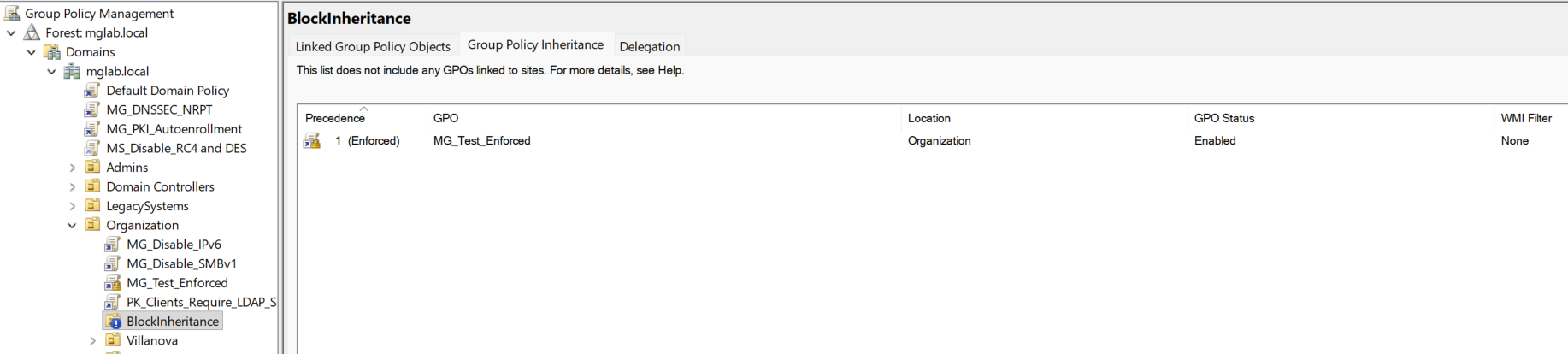
When enabled on an OU, Block Inheritance stops higher-level GPOs that are normally inherited. Higher-level GPOs marked Enforced are the exception and continue to apply.
Block Inheritanceinterrupts inheritance of non-Enforced GPOs from parent OUs, the site, and the domain;- a higher-level GPO marked
Enforcedcontinues to be inherited through the blocked branch.
The decisive point: what really happens in a conflict
The rule is not complex, but it must be read in the correct context: scope, hierarchy, inheritance, and precedence.
Enforced is not a force switch
The common mistake is to think of Enforced as a button that forces a GPO to apply in every situation. It is not.
Enforced means that a GPO has priority over normally inherited GPOs when their settings conflict. It does not change the OU hierarchy, bypass Security Filtering or WMI Filtering, fix a poor OU design, or turn a weak policy into an absolute override. It does, however, prevent Block Inheritance from excluding that GPO when it would normally be inherited by the target branch.
Why it is used so often
Enforced is often used because the OU structure or GPO management is less coherent than it should be. Typical signals include:
- an overly permissive domain baseline;
- OUs created without a consistent role, target, or ownership model;
- GPOs linked without a clear inheritance design;
- exceptions introduced as quick fixes and left in production;
- administrators forcing a local policy instead of correcting the root cause.
In these conditions, Enforced is a symptom of a poor design, not a governance solution.
The sound design rule
If the OU structure is correct, GPO link order is sensible, and branch precedence is clear, Enforced should rarely be necessary:
- domain GPOs provide the governance baseline;
- OU GPOs provide controlled exceptions;
- OU design provides the model;
- precedence is defined by inheritance and link order, not by a permanent flag.
When Enforced is justified
Enforced is reasonable only when:
- a security policy must prevail over a broader baseline;
- the precedence difference is documented and approved;
- the branch has a clear owner and a specific operational reason;
- the team can explain why the exception exists and how it will be removed.
The practical wording for an administrator
The accurate sentence is not "I forced the GPO". It is:
I elevated this GPO's application priority in the specific branch to manage a settings conflict.
That wording describes the actual behavior without promising an absolute override.
Conflicts and real-world cases: what really happens
Scenario 1: domain baseline plus local exception
Imagine a domain GPO that sets Interactive logon: Message title and other security policies, an OU for production servers, and a GPO linked directly to that production OU with Enforced.
The OU-linked GPO has priority over higher-level GPOs. This is expected when the policy is correctly designed. If the GPO remains forced for years without review, however, the domain baseline is no longer a real standard: it is only a historical reference.
Scenario 2: isolated OU where a base policy still applies
If an OU has Block Inheritance enabled, domain and parent-OU GPOs that are not marked Enforced are no longer inherited. An Enforced domain baseline continues to apply and is not excluded from the child branch.
This creates a common observation problem: an administrator sees unexpected behavior and assumes that a GPO is doing nothing, while the real explanation is that the GPO is either excluded by inheritance or deliberately preserved by Enforced.
Scenario 3: an Enforced GPO after an object is moved
This is common in large environments. A server or group of assets is moved to a new OU, the relevant GPO is marked Enforced, and years later the asset is assigned to a different branch while the policy is left in place. The result is a behavior applied in a context that is no longer consistent with current governance.
Conflict 1: domain GPO versus an Enforced OU GPO
GPO-Domain-Security sets X at the domain and GPO-Prod-Hardening sets Y at OU=Production with Enforced. For objects in Production, Y wins. The domain GPO does not disappear; it remains applicable for other settings and branches, but loses this setting conflict in the Production scope.
Conflict 2: two Enforced GPOs
If GPO-Prod-Lockdown at OU=Production sets A and GPO-Prod-Exceptions at OU=Production\Servers sets B, the more specific GPO can prevail for the target branch. When specificity is equivalent, the effective precedence shown by GPMC, including link order and processing order, decides. There is no reliable rule that simply says "the Enforced GPO always wins".
Conflict 3: Enforced versus Local Policy
If Local Policy sets L, a domain GPO sets D, and an applicable Enforced OU GPO sets E, the local value is processed first and can be overwritten by the domain and OU GPOs. When the OU GPO applies to the correct scope, E is the final value for the conflict.
Conflict 4: Block Inheritance versus an Enforced GPO
If GPO-Domain-Baseline is linked to the domain and marked Enforced, GPO-Production-Special is linked to OU=Production, and OU=Production\Workstations has Block Inheritance, the block excludes normally inherited domain and parent-OU GPOs but not the Enforced domain baseline. The baseline still applies to Workstations. A GPO linked directly to Workstations also applies; if it configures the same setting, verify final precedence with GPMC, gpresult, or RSOP.
Complete combination table
The table uses the same example throughout: Interactive logon: Message text for users attempting to log on is configured with different values (A, B, C...) in the listed GPOs. The result assumes that the GPOs are applicable to the analysed computer or user; filtering, loopback, and permissions can exclude a GPO before precedence is evaluated.
| Combination | Example configuration | Final value or behavior |
|---|---|---|
| Complete LSDOU, no exceptions | Local=A, Site=B, Domain=C, OU=D, Child OU=E | E wins because the child OU is processed last. If E does not configure the setting, the result falls back to D, then C, B, and A. |
| Local Policy versus domain GPO | Local=A, Domain=C | C wins for the domain computer. |
| Domain GPO versus OU GPO | Domain=C, OU=D | D wins for objects in the OU because it is more specific and processed later. |
| Parent OU versus child OU | Parent OU=D, Child OU=E | E wins for objects in the child OU. The parent remains effective for settings not configured by the child. |
| Two GPOs at the same level | Two GPOs linked to one OU set A and B | The effective GPO link order in GPMC decides. Non-conflicting settings from both can remain applied. |
| Domain GPO versus OU GPO with Enforced on the OU | Domain=C, OU=D with Enforced | D wins the conflict; Enforced also protects it from normally inherited lower-branch conflicts. |
| Enforced parent GPO versus normal child GPO | Parent OU=D with Enforced, Child OU=E without Enforced | D wins the conflicting setting because Enforced prevents the normally inherited child GPO from overwriting it. |
| Two Enforced GPOs at different levels | Parent=D Enforced, Child=E Enforced | Verify effective scope, processing order, and GPMC precedence; counting Enforced flags is not enough. |
| Block Inheritance without Enforced | Domain=C, Parent=D, child OU has Block Inheritance | Normally inherited domain and parent GPOs are excluded. GPOs linked directly to the child still apply. |
| Block Inheritance with an Enforced domain GPO | Domain=C with Enforced, child OU has Block Inheritance | C still applies unless a higher-precedence applicable GPO overrides the setting. |
| Block Inheritance with an Enforced parent GPO | Parent=D with Enforced, child OU has Block Inheritance | D continues to apply; non-Enforced parent GPOs are blocked. |
| Direct child OU GPO with Block Inheritance | Child OU has Block Inheritance and directly linked GPO=E | E applies and can win against normally inherited parent settings. |
| Direct child OU GPO with Enforced | Child OU has Block Inheritance and direct GPO=E with Enforced | E applies and keeps its precedence against applicable lower-branch conflicts. |
| Setting only in a blocked parent GPO | Parent=D, child has Block Inheritance, no Enforced GPO | The parent setting is not applied; there is no inherited final value for that setting. |
| Setting only in an Enforced parent GPO | Parent=D with Enforced, child has Block Inheritance | D remains the final value because the Enforced GPO still applies. |
| GPO excluded by filters | A GPO sets Z but fails Security or WMI Filtering | Z cannot win because the GPO never enters precedence resolution. |
| Applicable GPOs with no setting conflict | Domain sets one setting to C, OU sets another to D | Both settings remain applied; precedence matters only when the same setting conflicts. |
The production rule is: first establish which GPOs are actually applied, then inspect link level, Block Inheritance, Enforced, and link order. Only then can you state which value wins. gpresult and RSOP show the real result on the analysed computer or user.
Operational truth
If GPO order is correct, the OU structure is healthy, and branch precedence is well defined, Enforced is rarely necessary. Domain GPOs and OU GPOs are normally enough to model precedence without a permanent exception.
This does not mean Enforced has no valid use. It is appropriate for a documented and justified exception. In practice, however, it is used much more often than necessary.
Why this matters in production
When conflicts are read in GPMC, many people treat Enforced and Block Inheritance as a way to make a policy "strong". They are not shortcuts. They are tools for governance exceptions. Without documentation, they create invisible drift.
Understanding effective precedence lets an administrator answer practical questions:
- Why is this policy applied instead of the domain baseline?
- Why does this OU ignore the standard baseline?
- Why do these servers not follow the domain security model?
- Who introduced this exception and why is it still present?
Concrete scenario to remember
A domain security baseline sets an administrative access policy and a standard timeout. The infrastructure team links a stricter GPO to the Servers OU and enables Enforced. Later, another team enables Block Inheritance in a child OU to solve a local problem and leaves it in place.
The result is a domain that is no longer predictable. Every change must be interpreted through historical exceptions, and the lifetime of a policy becomes difficult to determine. The issue may remain invisible until a new standard or application depends on normal inheritance.
How to read the real result in gpresult
The important question is not only whether a GPO exists. Check which GPO the computer finds in its branch, which one wins the conflict, and which one was excluded by Block Inheritance. Confirm the effective result with gpresult or RSOP.
Lab simulation: a model worth reproducing
The most useful way to understand the behavior is to reproduce a small AD topology.
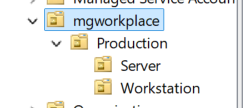
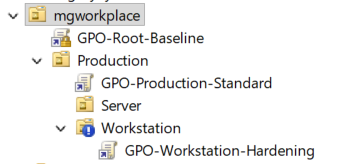
Lab topology
Set up:
- Domain
LAB.local; - OU
Production; - OU
Production\Servers; - OU
Production\Workstations.
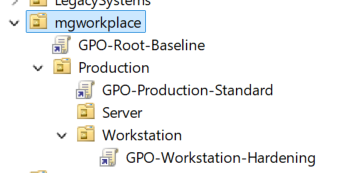
Link the GPOs as follows:
GPO-Root-Baseline-> domain;GPO-Production-Standard->Production;GPO-Workstation-Hardening->Production\Workstations.
Use observable test settings:
Computer Configuration\Policies\Windows Settings\Security Settings\Local Policies\Security Options\Domain member: Maximum machine account password age;Computer Configuration\Policies\Windows Settings\Security Settings\Local Policies\Security Options\Interactive logon: Message text for users attempting to log on.
The setting is less important than the relationship between OU level, link order, Enforced, and Block Inheritance.
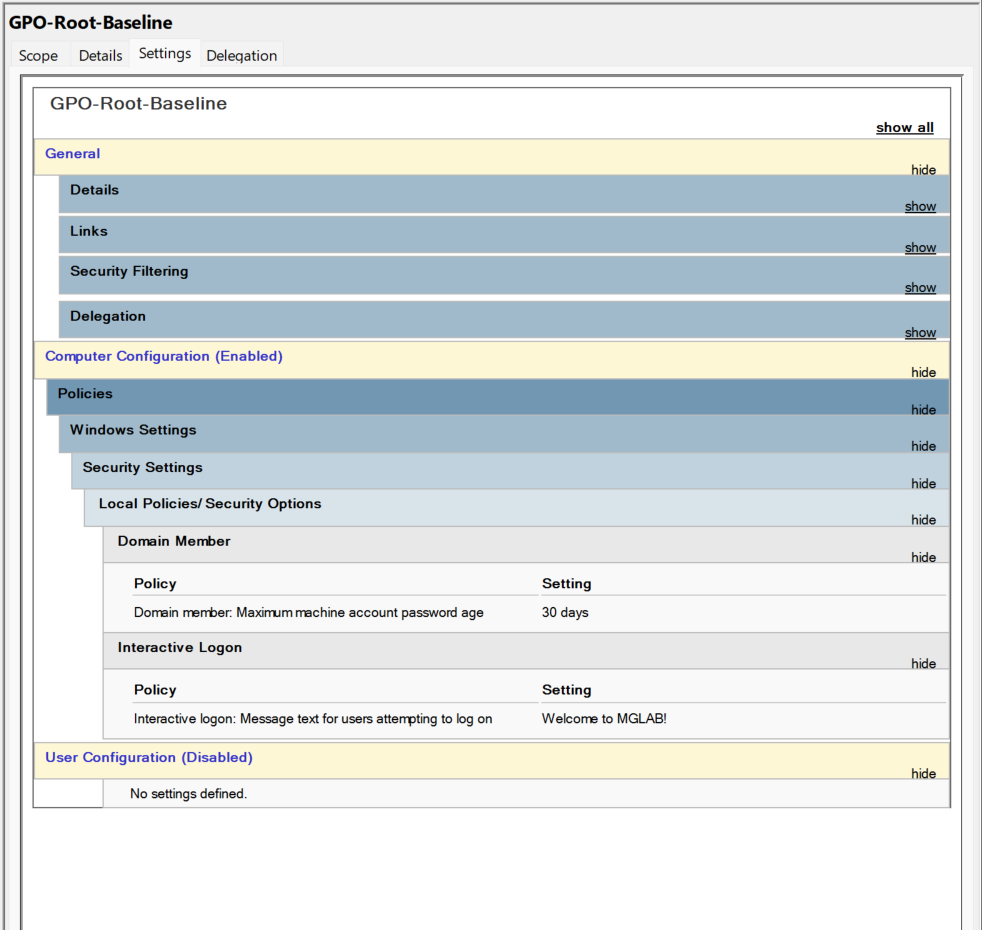
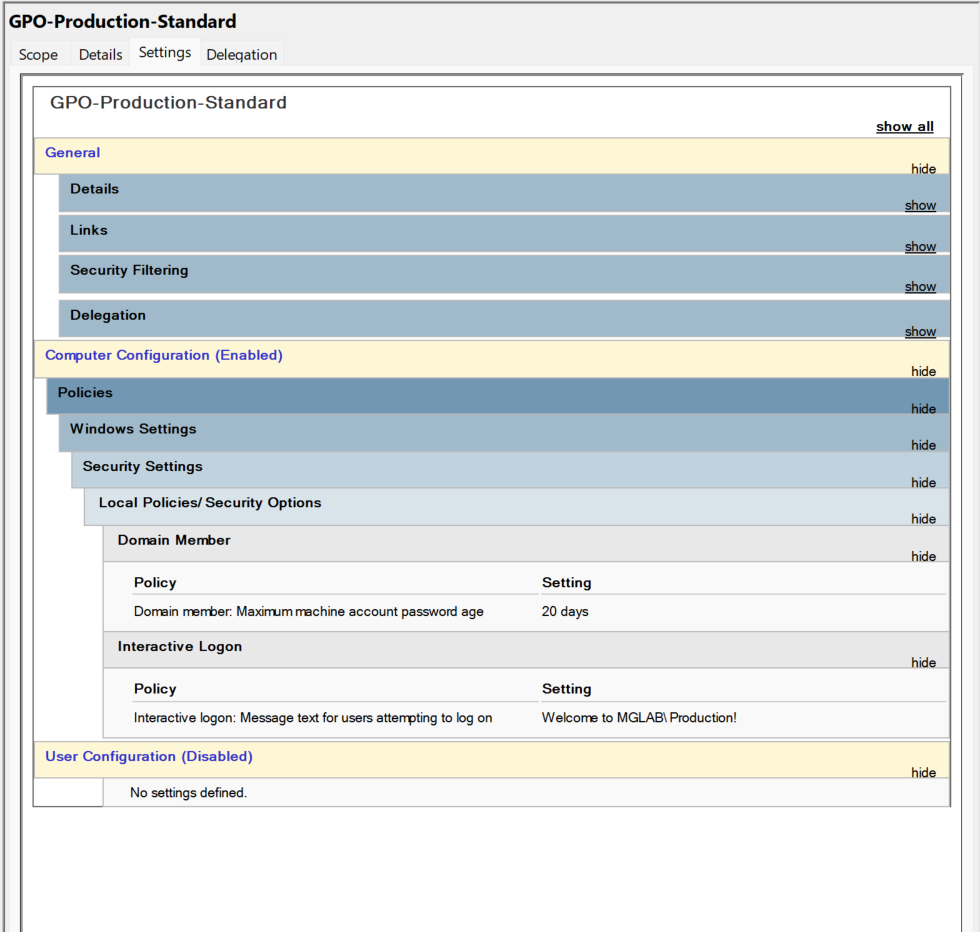
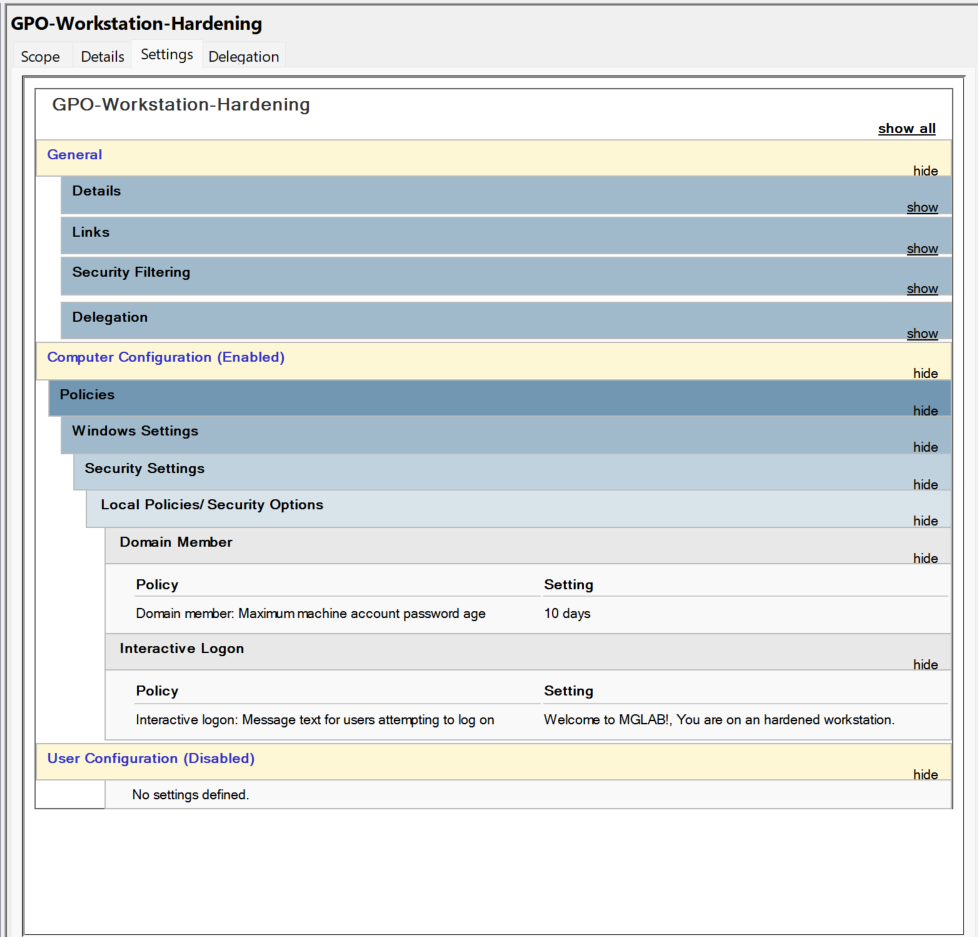
Lab 1: domain GPO versus OU GPO
Setup
GPO-Root-Baseline: sets value A;GPO-Production-Standard: sets value B;Productionis a normal OU with noBlock Inheritance.
Expected result
The Production OU inherits the domain GPO, but the GPO linked directly to the OU has priority.
Expected output:
GPO-Production-Standardwins over the domain value for objects inProduction.
This is the basic demonstration that inheritance separates the domain baseline from a local exception.
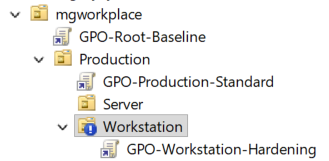
Lab 2: Block Inheritance on an OU
Setup
GPO-Root-Baselinelinked to the domain;GPO-Production-Standardlinked to theProductionOU;- enable
Block InheritanceonProduction\Workstations.
Expected result
Production\Workstations does not inherit the domain GPO or the parent-OU GPO when those GPOs are not marked Enforced. The child branch is isolated from normal higher-level inheritance, while higher-level Enforced GPOs continue to apply.
This demonstrates that Block Inheritance cuts normal inheritance; it is not a precedence override and cannot block a higher-level GPO marked Enforced.

Lab 3: Enforced on the child GPO
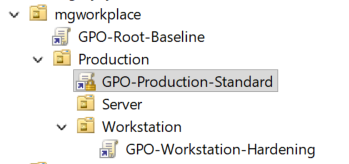
Setup
GPO-Root-Baselinesets value A on the domain;GPO-Production-Standardsets value B on theProductionOU;- mark
GPO-Production-StandardasEnforced.
Expected result
Even when the domain GPO has a different value, the Enforced OU GPO wins the conflict. The behavior can look as if the policy is being forced regardless of domain or site configuration.
Lab 4: Block Inheritance + Enforced
This is the most instructive case.
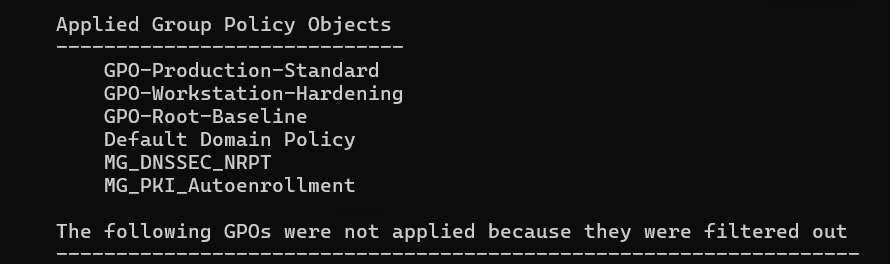
Setup
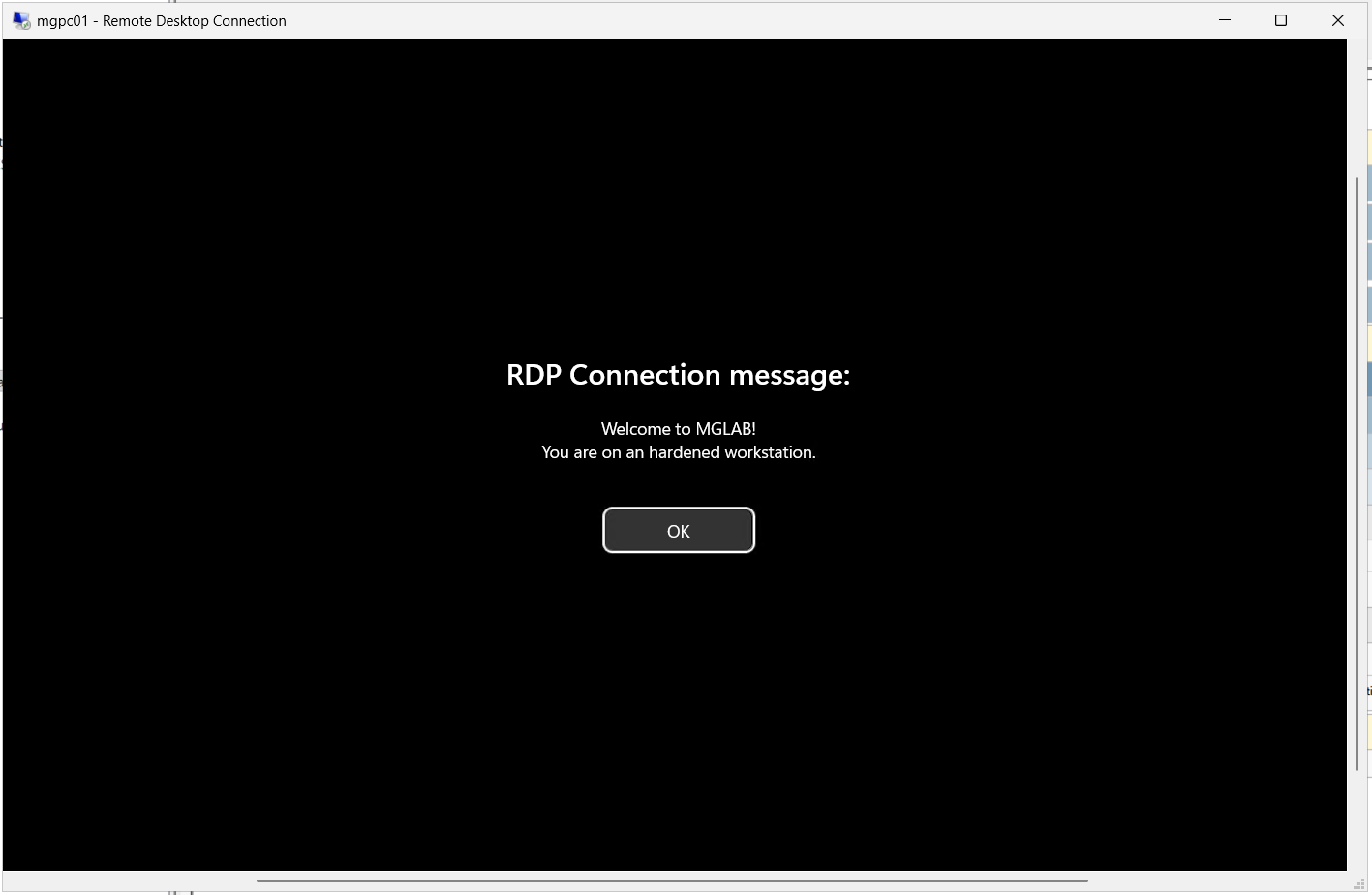
GPO-Production-Standardlinked toProduction;GPO-Workstation-Hardeninglinked toProduction\Workstations;Block Inheritanceenabled onProduction\Workstations;Enforcedenabled onGPO-Root-Baseline.
Expected result
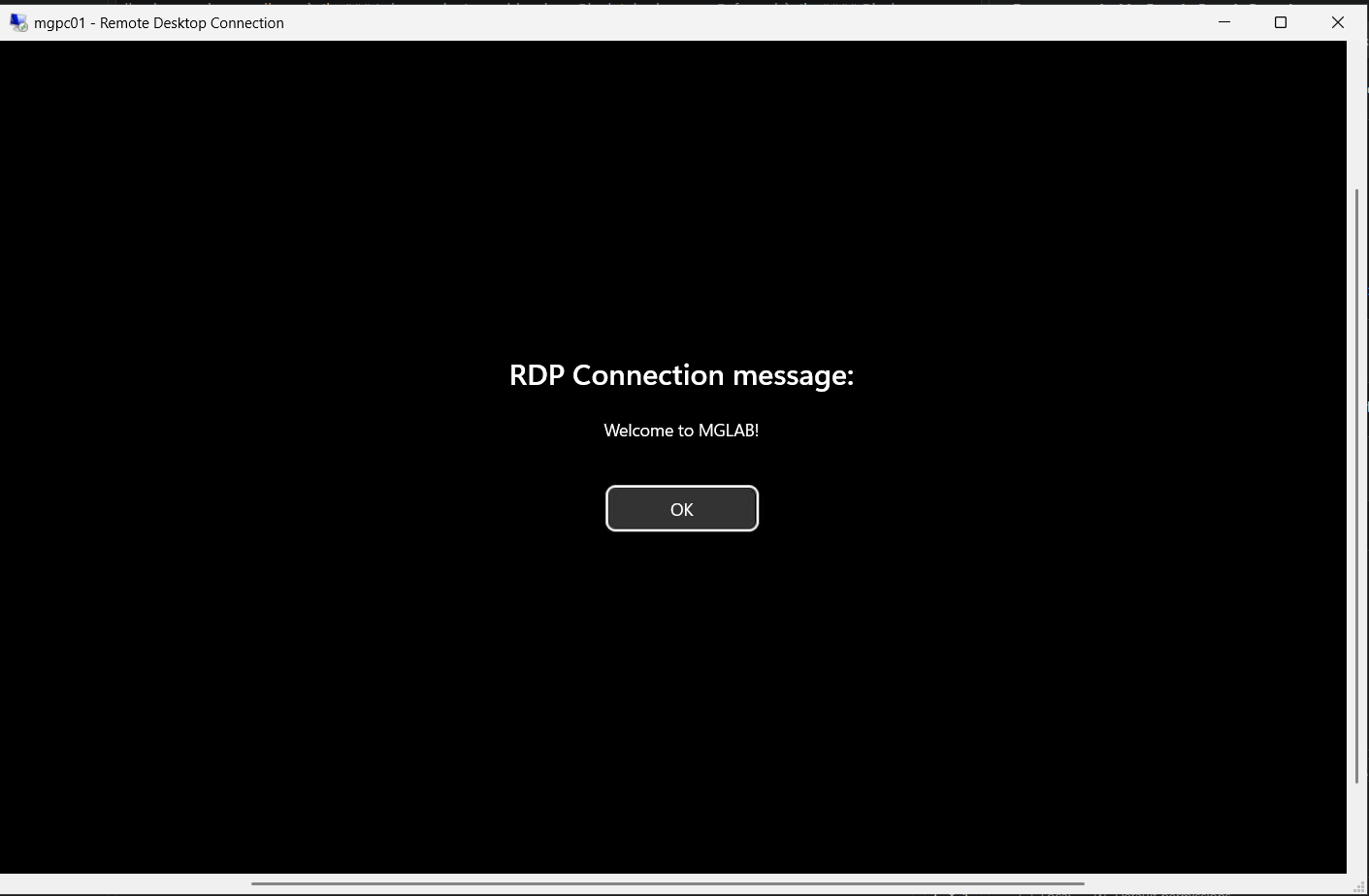
The Production GPO is not inherited by Production\Workstations because normal inheritance is interrupted. However, the higher-level Root GPO is still applied because it is Enforced, bypassing the levels where Block Inheritance is active.
This test demonstrates that:
Block Inheritancestops normal inheritance;Enforcedchanges the weight of the linked GPO;- neither mechanism is a solution by itself: both must be read in the context of the OU tree.

Reading effective behavior in production
To understand a real issue, check three things together:
- where the GPO is linked;
- which OU has Block Inheritance;
- which GPOs are marked Enforced.
These reveal whether the policy was a controlled exception or has become an accidental rule.
Simple reading rule
- domain GPO = governance baseline;
- OU GPO = local exception or branch standard;
Block Inheritance= isolation from the higher-level branch;Enforced= prioritization of a specific GPO.
If a configuration remains active without documentation, it is a governance problem, not a technology problem.
Recurring production mistakes
1. Enforced used as a permanent fix
A team restores a security policy in an OU and marks the GPO Enforced to be safe. Years later, nobody remembers how much of the domain baseline it overrides.
2. Block Inheritance left after a local fix
The first response is to block inheritance. The missing second step is to remove the exception after the problem is fixed. The OU becomes a small independent policy domain.
3. Missing documentation
The critical GPO has an owner but no record explaining why it is Enforced or why Block Inheritance was enabled. A later change then produces a real operational defect.
4. Reading gpresult without the OU tree
A GPO can appear effective while being only the strongest policy in the branch, not the correct policy for the general model.
Operational decision tree
When you face a real case, use the following decision path.
Use Enforced only when
- the policy must specifically prevail over a broader baseline;
- the difference has been assessed and approved by governance;
- there is a written record of the exception;
- the effect has been tested on the target OU and clients.
Avoid Enforced when
- the policy is a temporary undocumented fix;
- the problem is outside the OU's actual scope;
- the root cause is link order or a duplicated GPO;
- the team cannot explain why the GPO must prevail.
Use Block Inheritance only when
- the OU must be isolated from a domain or parent-OU baseline;
- the excluded policy is genuinely unwanted in that branch;
- rollback has an owner and a defined timeline.
Avoid Block Inheritance when
- it is being used because the problem is not understood;
- it is only bypassing a base policy without analysing the cause;
- there is no rollback criterion.
Safe change method
This is fundamental in an enterprise environment: do not change first and investigate later. Verify first, change second, validate third.
Minimum pre-change checklist
- identify the GPO;
- document whether it is linked to the domain, site, or OU;
- check whether
EnforcedorBlock Inheritanceexists in the branch through GPMC; - run
gpresult /h report.htmlon a test client; - use
rsop.mscorGet-GPResultantSetOfPolicyto confirm effective order; - assess which OU contains the final client objects;
- define rollback before applying the change.
Recommended process
- test in a pilot OU;
- validate on a subset of systems;
- verify critical settings;
- check access or application logs;
- obtain change approval;
- roll out to production;
- monitor for 24-48 hours.
Useful validation commands
Effective policy on a client
gpresult /h C:\Temp\gpo-report.html
GPO links and OU inheritance
Get-GPInheritance -Target 'OU=Production,DC=LAB,DC=local'
Linked GPO
Get-GPLink -Guid (Get-GPO -Name 'GPO-Servers-Hardening').Id -Target 'OU=Production,DC=LAB,DC=local'
Detailed GPO report
Get-GPOReport -Guid (Get-GPO -Name 'GPO-Servers-Hardening').Id -ReportType XML -Path C:\Temp\gpo-servers.xml
These commands matter because operators often read the GPO definition instead of the final result on a specific host.
Production-like lab example
Imagine this situation:
- the domain security baseline enforces an administrative access policy and a standard timeout;
- an infrastructure team in the
ServersOU wants a stricter setting for domain controllers or critical servers; - the team links a GPO and enables
Enforcedso it cannot be overwritten by the domain; - later, another team enables
Block Inheritancein a child OU to solve a local problem and then forgets about it.
The result is a domain that is no longer predictable. Every new change is interpreted through historical exceptions, and the lifetime of a policy becomes impossible to determine.
This type of drift may not leave an obvious visual trace. It emerges when a change to a standard or a new application expects normal policy behavior and discovers that historical exceptions take precedence across the structure.
Final review checklist
- Is the GPO linked to the domain, site, or OU?
- Are any GPOs marked
Enforced? - Do any OUs have
Block Inheritance? - Is the exception documented?
- Has security approved the behavior?
- Was the GPO tested on a pilot client?
- Is rollback defined and tested?
- Was the effective result checked with
gpresultorRSOP? - Is the behavior consistent with the domain baseline?
If even one answer is missing, the exception may have become an operational risk.
Conclusion
Enforced and Block Inheritance are not configuration errors. They are powerful exception mechanisms. Left unmanaged, they turn a governed policy system into a collection of permanent exceptions.
The important question is not whether they are right or wrong in the abstract. It is where they are used, why they are used, and whether rollback and governance exist. A clear baseline and periodic review of exceptions are what separate a managed domain from an accidental one.
In an Active Directory environment, the difference between a correctly designed GPO and a permanent exception is often the difference between a manageable incident and a distributed security or operational failure.
An
EnforcedGPO is not a permanent solution. It is a specific precedence decision.Block Inheritanceis not a correction. It is an inheritance cut. Without documentation, both are technical debt.
The contents of this guide are provided for informational purposes only, without warranties. Application of any procedure is at the user's own risk. Disclaimer.
Appreciation
If this guide is useful, leave a like.
Related guides
Keep exploring
ACL / Active Directory
SYSVOL Permissions in Active Directory: Baseline and Drift
Read the guide->Active Directory / Delegation
GPO Security Filtering vs Delegation: What's the Difference?
Read the guide->Active Directory / Domain Controllers
Protected Users in Active Directory: what it is, limits, adminCount, and rollout without lockout
Read the guide->ACL / Active Directory